
Bullion investors place excessive focus on premiums. In doing so, many neglect the costs of selling (which can vary dramatically by dealer), storage and insurance, which dominate over the long term.
When selecting counterparts for bullion investments, the investment’s full life cycle should be considered: buying, holding and selling. It is important to build optionality and flexibility into all arrangements in case circumstances change.
Each stage has costs. Excessive focus on purchase premiums can cloud judgement on the relevance of holding and selling costs. Some dealers make more on sales than purchases, and your options with some providers may be limited. Even during the recent bull run that led to scarcity and unavailability, wide sale discounts have been common.
When bullion is purchased for the long term, the cost of vaulting and insurance is a much more important consideration than the premium paid.
Consider the following from one of our contacts:
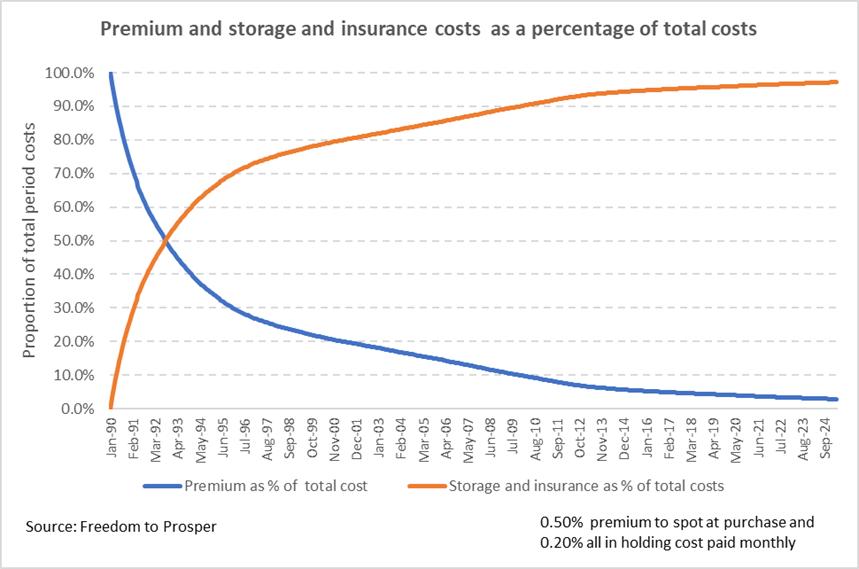
By May 2025, his accumulated storage and insurance costs were US$ 209,084 or 17.5% of the invested amount.
The purchase premium was US$ 6,059.47 or 0.50% of the purchase amount, as it had been 35 years earlier. Due to the price appreciation and holding duration, the premium he paid turned out to be a tiny element of his total costs yet had dominated his initial thinking.
Storage and insurance costs reward an essential service which protects bullion and keeps it within the chain of integrity, therefore enhancing its liquidity and utility. Some look at this ‘cost’ as a downside of owning bullion, but fail to appreciate that financial assets also come with costs such as custody charges and have complex ownership implications.
It is worth paying a bit more to secure a quality service, strong security arrangements and optionality with respect to logistics and alternative locations. Holding fully allocated and segregated bullion within professionally managed facilities with third party audits and broad insurance coverage has a cost which in our view is always worth paying.
The price and quality of service in this area varies widely, even for equivalent offerings utilising the same vaults. Finding the best price and suite of services is therefore an important strategic consideration, as changing providers involves additional costs and inconvenience.
Disclaimer
Important risk warning - NOT INVESTMENT, TAX or LEGAL ADVICE
This free document is produced to be thought provoking and help readers ask the right questions with respect to how and where to hold precious metals.
It does not constitute investment tax or legal advice and is not a solicitation to participate in any investment or activity. Opinions and views expressed are based on private research, publicly available resources and our own knowledge. It is intended for educational purposes only and is subject to change without notice.
All content should be considered with reference to individual circumstances/suitability and no opinions should be considered in isolation.
Past performances, outcomes or forecasts are not reliable indicators of future events. Investment in precious metals involves many risks and investors may not achieve their objectives or even the return of initial capital. Independent professional investment, taxation and legal advice should be sought before making all investment decisions including where and how to store bullion and it is important to never invest more than you can afford to lose.
Overseas assets are denominated in currencies that differ from the home currency and movements in exchange rates may increase or decrease returns. Taxation may impact capital gains on bullion and local laws and regulations vary. Different structures or arrangements to hold and buy bullion have variant tax implications depending on the jurisdiction of the investor and the location. Some structures limit the jurisdiction or type of investor who can invest and advice should be sought before selecting any investment vehicles, undertaking any movements of bullion or changes to storage arrangements. Regulations, laws and taxation are constantly changing potentially impacting the appropriatness of past decisions and existing arrangements.
In most jurisdictions physical bullion is Not Regulated as a financial asset by the FCA, FINMA, SEC or any other regulatory body and consequently investors do not usually have access to compensation schemes like the Financial Ombudsman Service or the Financial Services Compensation Scheme etc. Different jurisdictions are subject to varying levels of regulation and protections. Independent advice should always be taken before investing, moving or changing storage arrangements.
Best efforts have been taken to ensure that the contents of this note are accurate, relevant and up to date at the time of issue but unintended errors may occasionally arise and we do not warrant its completeness or accuracy.
Vaultonomics is a private unregulated undertaking that focuses on providing bespoke research and due diligence to specific entities or individuals on the storage and logistics of bullion holdings. Nothing in this note should be taken as automatically relevant to anyone and Vaultonomics does not hold itself out to be a financially regulated entity or to offer advice to the general public.