
Where and how bullion is stored is an important strategic issue for all investors. No location or approach is perfect, and future changes can disrupt planning and undermine the value of different locations. This makes logistical flexibility an essential component of any strategy.
Flexibility is best achieved and managed by diversification of storage location and approach. The example below depicts an effective storage strategy that provides flexibility through the use of multiple locations, different types of facilities and operators across various legal and political jurisdictions.
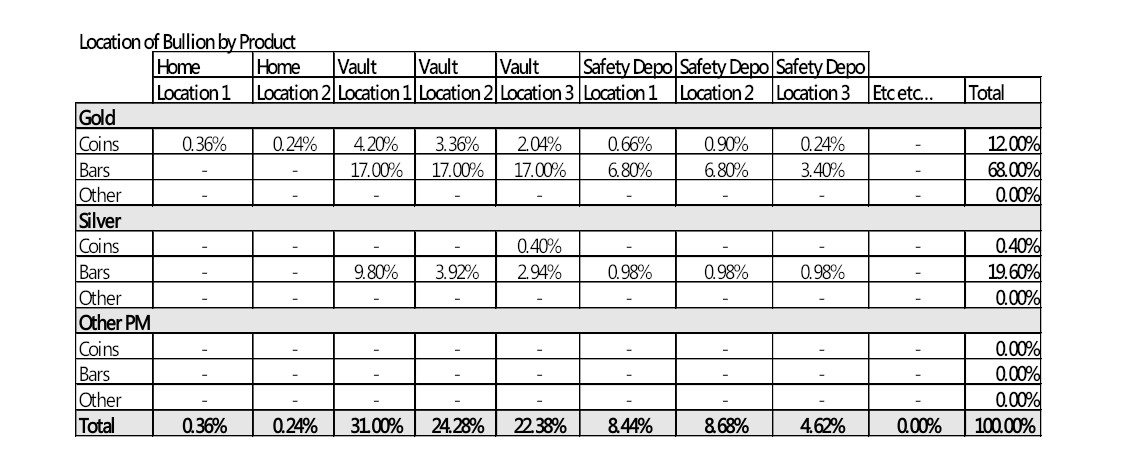
While large holders will require more locations than shown in this example, smaller ones may be unable to diversify extensively at a reasonable cost. However, the principle is clear; diversify by jurisdiction, location, provider and approach.
Security, privacy, accessibility and cost are always key considerations alongside practicality and individual family needs. Flexibility enables planning to respond to changing circumstances or challenges, while helping to maintain the protection that bullion offers.
Some of the most common storage types comprise: at home, bank safety deposit facilities, non-bank safety deposit facilities and vaults. Each type of storage has trade-offs, but when combined in a well-planned strategy can enhance flexibility and dramatically reduce current and future exposures. The risks and opportunities for each should be thoroughly understood before commitment, with the amount of bullion put in each weighted accordingly:
Some of the most common storage types comprise: at home, bank safety deposit facilities, non-bank safety deposit facilities and vaults. Each type of storage has trade-offs, but when combined in a well-planned strategy can enhance flexibility and dramatically reduce current and future exposures. The risks and opportunities for each should be thoroughly understood before commitment, with the amount of bullion put in each weighted accordingly:
For larger holders - especially multi-jurisdictional families - the range of options is broad. For smaller investors there are fewer options, but those covered above and below are usually sufficient to improve flexibility and reduce risk. As your bullion holdings and life circumstances change, existing arrangements should be reconsidered.
Creating a flexible and safe storage footprint may increase costs as individual economies of scale can be lost. However, for most families the peace of mind from knowing that you have maximised your family’s protection is priceless. The case for buying insurance/protection rests on risks that can be highly sensitive to location. Not building this into the bullion management strategy is a big mistake.
Home storage
Physical ownership under your exclusive private control removes exposure to many risks but has costs. Insurance for bullion stored at home can be challenging to secure, is often limited in scale and may be used by predatory tax departments looking for estate duties. Gold is not truly private once insured.
Diversifying where exactly in the home bullion is stored is sensible and there are solutions that reduce risk, but the risk will never entirely disappear. Make sure that someone trustworthy knows where you hide your gold, or it could become a future windfall for someone else to find.
Having a home safe is useful, but not enough on its own. A strategy focussed on concealment, alerts and diversions that waste a criminal’s time dramatically improve efficacy.
Bank safety deposit facilities
Banks are increasingly withdrawing from providing safety deposit services with those that do often utilising older technology which is inferior to that of modern facilities. Crucially, regulated banks are part of the financial system and are vulnerable to political pressure, making them unattractive for large core holdings.
Access is generally limited to banking hours and in the event of a bank becoming troubled, access may be withheld for months.
Contents are not insured by the bank so specialist third party insurance is needed. This may not be available in all jurisdictions and tends to be limited in scale with unreliable caveats.
Holding a small amount of bullion in a bank can make sense depending on available alternatives, cost, jurisdiction and the specific bank concerned.
Non-bank safety deposit facilities
These tend be unregulated and many have more modern facilities and better security technology than banks. Unlike most banks, these providers actually want to be in the security storage business which often means you are valued much more as a customer.
Most facilities offer good private access (often 24-7) and can store large amounts of bullion at a low cost.
As with vaults, the integrity of the deposit box provider, its ownership structure and links to certain jurisdictions are key factors to consider, in addition to security. When facilities are shared or not owned by the provider, extra caution should be built into due diligence.
Bullion held in safety deposit boxes (and at home) is less liquid as it needs to be collected, transported and tested prior to sale, which should be considered upfront. Having trusted contacts who can access material on your behalf can speed up this process. Some bullion dealers offer boxes with almost identical sale liquidity, to sales from a vault. This is only possible because the box contents are known by them and monitored. In general, liquidity and convenience come at a cost in terms of privacy.
Facilities are often not insured but taking out private insurance for specific box contents is sensible. However, this can reduce privacy through disclosure. Insurance terms can often be attractive, benefiting from economies of scale. As always, the terms and what is excluded need to be appraised.
Vaults and other facilities
Non-bank vaults in the right location operated by organisations that pass in-depth due diligence should make up the core of a bullion holding.
Vaults usually offer full insurance coverage and a range of services that enable bullion to be moved and quickly sold, boosting liquidity.
Disclaimer
Important risk warning - NOT INVESTMENT, TAX or LEGAL ADVICE
This free document is produced to be thought provoking and help readers ask the right questions with respect to how and where to hold precious metals.
It does not constitute investment tax or legal advice and is not a solicitation to participate in any investment or activity. Opinions and views expressed are based on private research, publicly available resources and our own knowledge. It is intended for educational purposes only and is subject to change without notice.
All content should be considered with reference to individual circumstances/suitability and no opinions should be considered in isolation.
Past performances, outcomes or forecasts are not reliable indicators of future events. Investment in precious metals involves many risks and investors may not achieve their objectives or even the return of initial capital. Independent professional investment, taxation and legal advice should be sought before making all investment decisions including where and how to store bullion and it is important to never invest more than you can afford to lose.
Overseas assets are denominated in currencies that differ from the home currency and movements in exchange rates may increase or decrease returns. Taxation may impact capital gains on bullion and local laws and regulations vary. Different structures or arrangements to hold and buy bullion have variant tax implications depending on the jurisdiction of the investor and the location. Some structures limit the jurisdiction or type of investor who can invest and advice should be sought before selecting any investment vehicles, undertaking any movements of bullion or changes to storage arrangements. Regulations, laws and taxation are constantly changing potentially impacting the appropriatness of past decisions and existing arrangements.
In most jurisdictions physical bullion is Not Regulated as a financial asset by the FCA, FINMA, SEC or any other regulatory body and consequently investors do not usually have access to compensation schemes like the Financial Ombudsman Service or the Financial Services Compensation Scheme etc. Different jurisdictions are subject to varying levels of regulation and protections. Independent advice should always be taken before investing, moving or changing storage arrangements.
Best efforts have been taken to ensure that the contents of this note are accurate, relevant and up to date at the time of issue but unintended errors may occasionally arise and we do not warrant its completeness or accuracy.
Vaultonomics is a private unregulated undertaking that focuses on providing bespoke research and due diligence to specific entities or individuals on the storage and logistics of bullion holdings. Nothing in this note should be taken as automatically relevant to anyone and Vaultonomics does not hold itself out to be a financially regulated entity or to offer advice to the general public.